All-or-nothing scope
Finance cannot go live until inventory is configured, which waits on procurement, which waits on a data cleanse. Nothing delivers value until everything does.
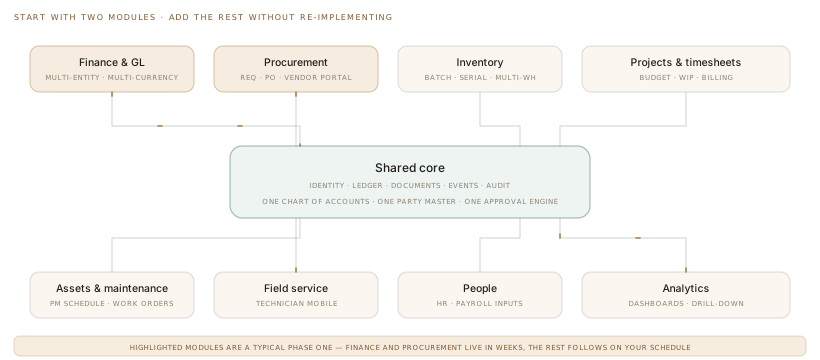
Most mid-size organisations do not fail at ERP because the software was wrong. They fail because the implementation was scoped as a transformation. SE-ERP is modular by design: deploy finance and procurement now, add projects and assets when you are ready, and keep your customisations through every upgrade.
The problem
You already know which processes hurt. What kills the project is a scope that touches every department at once, a customisation layer that cannot be upgraded, and a go-live date that slips until the sponsor changes job.
Finance cannot go live until inventory is configured, which waits on procurement, which waits on a data cleanse. Nothing delivers value until everything does.
The workflow you needed was built by modifying the core. Two years later you are three versions behind because upgrading means redoing the modifications.
GST returns, e-invoice IRNs, e-way bills and TDS get handled by an add-on, a consultant's macro, or a person. Every filing season is a scramble.
What it does
General ledger with multi-entity and multi-currency books, receivables and payables, bank reconciliation with statement import, and cost centre allocation. The close checklist is a first-class feature: it shows exactly which task is blocking, who owns it, and what the dependency is — rather than a controller chasing four people over email.
GST-ready invoicing with HSN and SAC on every line, e-invoice IRN generation and e-way bill hooks through a GSP, reverse charge handling, TDS deduction and certificates, and GSTR-1 and GSTR-3B data extracts that reconcile against your books before you file rather than after a notice arrives.
Boundary: we produce the data and the reconciliations. We are not your tax advisor and we do not sign off a return — your chartered accountant does, and the system is built so they can verify rather than trust it.
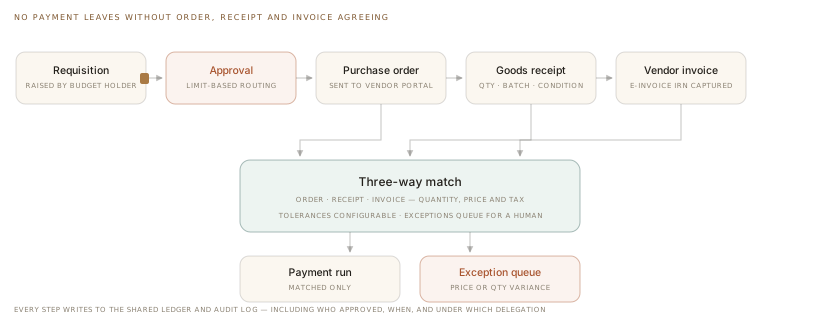
Requisition, approval, purchase order, goods receipt, invoice — with the three-way match enforced rather than reconstructed. Vendors get a portal to submit invoices and track payment status, which removes most of the phone calls your accounts team currently fields.
Multi-warehouse stock with batch and serial tracking, reorder points and cycle counting. Asset registers carry warranty, service history and spares consumption — which is how a camera estate or a display fleet stops being a spreadsheet that nobody has updated since commissioning.
Project budgets against actuals, timesheets that feed both billing and payroll inputs, work orders dispatched to a technician's phone, and spares consumption booked back to the asset and the job. For a services business this is the module that decides whether you know your margin per project before the year ends.
Every function is a documented REST or GraphQL endpoint, and workflow extensions attach through scripting hooks rather than modifications to the core. That is the mechanism that keeps your customisations through upgrades — they are extensions with a contract, not edits to our source. Controls are standard: SSO, granular roles, maker-checker approvals and a field-level audit log.
Module explorer
Each module is independently deployable against the shared core. The most common starting pair is Finance plus Procurement.
The module almost everyone starts with, because it is where the pain is measurable. Ledger, receivables, payables, banking and statutory output, with the period close instrumented so you can see it shortening month over month.
Multi-entity, multi-currency, inter-company.
Ageing, dunning, credit limits, collections.
Invoice capture, approval, payment runs.
IRN, e-way bill, GSTR extracts, challans.
Usually the second module, because it is where the leakage is. Enforced approval chains, a vendor portal that removes phone traffic, and stock accuracy that finance can actually rely on at close.
Approval by value, category and cost centre.
Invoice submission and payment visibility.
Bins, transfers, cycle counts, batch and serial.
Freight, duty and insurance allocation.
For services and infrastructure businesses this is where margin lives. Budget against actual in one view, timesheets that reach both the invoice and the payroll input, and an asset register that field engineers actually update because the mobile app is faster than the spreadsheet.
Budget, commitment, actual, milestone billing.
Approval, billing rates, payroll inputs.
Warranty, service history, depreciation.
Dispatch, offline capture, spares consumption.
Deliberately scoped as HR operations and payroll inputs, not a full payroll engine. Most organisations already have a payroll provider they trust and a statutory relationship they will not move. We feed it accurately instead of replacing it badly.
Records, documents, reporting lines.
Policies, approvals, biometric import.
Structured export to your payroll provider.
Expense claims and advance settlement.
Role-based dashboards with drill-down to the underlying document, because a number nobody can trace is a number nobody trusts. Everything is also available through the API, so if your team prefers their own BI tool, use it.
Per role, drill-down to source document.
Saved views, scheduled email delivery.
Incremental extract to your own stack.
Alerts on ageing, stock and budget breach.
Specifications
Interoperability
Naming a system states interoperability, not partnership or endorsement.
Deployment
We run it, patch it and back it up. The default for organisations without a platform team.
Deployed into your account under your controls, with our Helm charts and runbooks.
For organisations with a data-locality mandate. Fully supported, including air-gapped.
Before you ask
Straight answer: often you should not. If you want the largest partner ecosystem and a product that will outlive any single supplier, buy SAP Business One. If you want the cheapest entry point and a huge module marketplace, Odoo is hard to beat. If your processes are standard and you want it working next month, Zoho will do it. Choose us when you need real customisation that survives upgrades, when your operations are unusual enough that standard modules fight you, or when you want the same team that runs your FIDS or camera platform to own the business systems too. If none of those apply, we will tell you.
Twelve weeks to a first module in production on a fixed scope, assuming your master data is available and someone on your side owns decisions. A second module typically adds six to eight weeks. Anyone promising a full multi-module ERP in six weeks is either not migrating your data or not testing. The long pole is almost always data cleansing, and we quote it separately so it stays visible instead of hiding inside a fixed price.
Because they are extensions, not modifications. Custom workflow attaches through scripting hooks and webhook events with a versioned contract, and custom fields and reports are configuration rather than schema edits. Before each quarterly release we run your extensions against the release candidate in your sandbox and fix breakage on our side. We do not fork the core for a customer, and if a requirement genuinely needs a core change we build it as a product feature or decline it.
You own it. On exit you get a full export in open formats — CSV plus a documented PostgreSQL schema dump — including documents from the object store, at no charge. We would rather you leave cleanly than stay because extraction is painful. Source escrow is available for on-premise deployments so a supplier failure does not become an operational crisis.
We produce the data and the reconciliations, and we generate IRNs and e-way bills through your GSP. We do not file on your behalf, we do not sign off a statutory audit, and we are not your tax advisor. Your chartered accountant remains in that role — the system is designed so they can verify the numbers against source documents rather than take them on trust.
High-frequency retail point-of-sale volumes, tens of thousands of concurrent users, and heavily regulated manufacturing process control. It is tested to around 500 named users and a few million transaction lines per entity per year. If you are beyond that, a tier-one ERP is the right answer and we will say so in the first call rather than discovering it during a performance test.
Also in the portfolio
The one that takes four people and a spreadsheet every month. We will scope that single process as a fixed-price first module, and you can judge us on it before committing to anything wider.