Serialised human judgement
Three controllers work 312 passengers one at a time while the phones ring. The hundredth passenger gets a worse outcome than the tenth, purely because of position in a queue nobody designed.
When weather closes a runway, the cost is not the delay — it is the two hours before anyone has re-accommodated 312 passengers, told them the truth, and protected the downline rotation. SE-IROPS is a multi-agent system that does that work inside your policy, at the speed the situation actually moves.
The problem
The controllers know what to do. There are simply more decisions than people, they all arrive at once, and every minute of delay in making them adds another passenger to the queue and another cascade downline.
Three controllers work 312 passengers one at a time while the phones ring. The hundredth passenger gets a worse outcome than the tenth, purely because of position in a queue nobody designed.
The rebooking happens at 19:10 and the passenger hears about it at 20:05, by which time they have already called the contact centre and been told something different.
Two passengers on the same fare, same disruption, get different entitlements depending on who handled them and how tired that person was. That is the inconsistency a regulator asks about later.
What it does
Each agent has one job, one set of tools and an explicit boundary. They coordinate through shared state rather than by calling each other, so any one of them can be paused without stopping the rest.
The watcher agent runs continuously across operational, weather, NOTAM, slot and crew feeds, maintaining a rolling risk score per flight and per connection. Its output is not "delayed" — it is "this inbound is 40 minutes late, which puts 34 connections at risk and breaks a crew duty limit at 23:10".
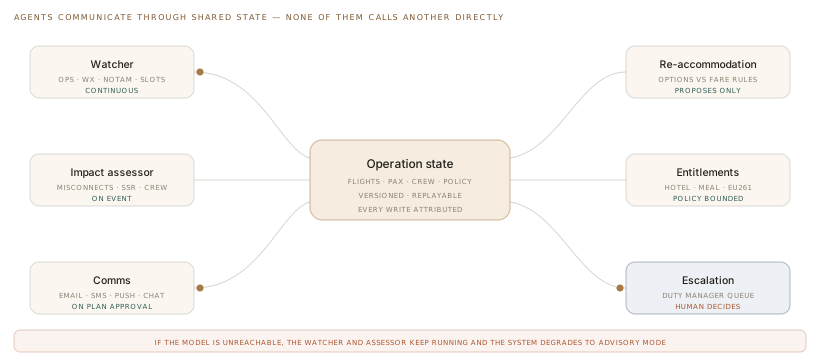
The assessor resolves the disruption into a ranked list of affected passengers using the priorities you configure — special assistance, unaccompanied minors, medical needs, onward connection value, loyalty tier, fare class. Prioritisation is a policy input. We will help you reason about it; we will not decide it for you.
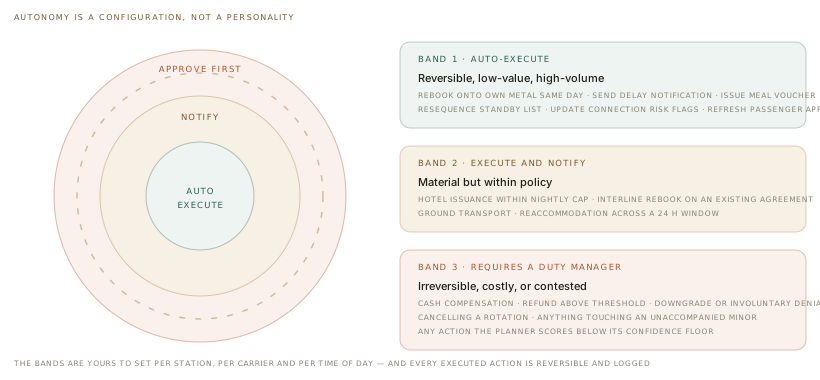
The planner generates re-accommodation options per passenger, checked against fare rules, interline agreements, seat availability and cost ceilings. It proposes; the action envelope decides whether the proposal executes immediately, executes with a notification, or waits for a duty manager.
Where a rules engine wins: if your re-accommodation policy is genuinely deterministic and your fare rules are simple, a rules engine is cheaper, faster and easier to certify. The agents earn their place when the space is too large and too contextual to enumerate — which is most real networks, but not all of them.
Hotel, meal and ground transport issuance runs against your caps and your supplier agreements. Compensation drafting is aware of EU261 and DGCA obligations, but it drafts — a human authorises money leaving the business, every time, without exception.
Per-passenger messages go out across email, SMS, app push and WhatsApp in the passenger's language, generated from the same decision record that drove the rebooking. The gate agent, the contact centre and the app all see the identical story — which is the single biggest determinant of how a disruption feels to the person living through it.
Every action records the inputs it saw, the policy version in force, the options considered, the option chosen and the reasoning. Any decision can be replayed. Before a policy change goes live it runs against historical disruptions in an evaluation harness, so you can see what would have happened differently.
Walk through it
A thunderstorm cell over the field at 18:42. Six steps, and where the humans stay in the loop.
Watcher · continuous
No flight has been declared delayed yet. The watcher has already flagged that this pattern historically cascades, and started scoring connections at risk.
Assessor · 5 minutes later
Planner · proposals with cost
Envelope · what ran without a human
The duty manager sees four decisions, not three hundred. Each arrives with the options considered and the reasoning, so the review takes under a minute each.
Comms · one narrative
Morning report
Illustrative figures for a single modelled event. Your baseline is measured during the pilot before anything is claimed.
Specifications
Interoperability
Naming a system states interoperability, not partnership or endorsement.
Deployment
No airline should switch this on at full autonomy on day one, and we will decline the engagement if you insist.
Agents watch and recommend. Humans execute everything. You measure agreement rate.
Band 1 actions execute automatically on one station or one disruption class.
Full envelope across the network, with duty managers handling only band 3.
Before you ask
Pay cash compensation, issue a refund above your threshold, downgrade a passenger, deny boarding involuntarily, or take any action involving an unaccompanied minor. These sit in band 3 permanently and cannot be moved into an automatic band through configuration. That is a product constraint, not a default setting.
The watcher and assessor keep running — they are conventional software over your feeds, not model calls. The planner and communications agents degrade to advisory: they surface the ranked impact and the option set to your duty managers, who execute manually as they do today. You lose the automation, not the situational picture. This is tested as part of commissioning, not assumed.
Every action carries a decision record: the inputs the agent saw at that moment, the policy version in force, the options generated with their costs, the option chosen and the reasoning, plus the human who approved it where applicable. The regulator export renders that as a per-passenger narrative with timestamps. If a decision cannot be explained, we treat that as a defect.
If your re-accommodation policy is genuinely deterministic and your fare and interline rules are simple enough to enumerate, a rules engine is cheaper to build, faster to run and far easier to certify — and we will tell you so during scoping rather than sell you this. The agents earn their cost when the option space is large, the trade-offs are contextual, and the passenger mix changes the right answer. In practice most networks are in the second category, but not all, and it is worth twenty minutes to establish which one you are.
Different jobs. Flyaza serves the customer's intent — they want to change something. IROPS serves the operation's obligation — something changed and the airline must respond. When a Flyaza conversation turns out to concern a disrupted flight, it hands over the context and the IROPS decision record so the traveller hears one consistent story rather than two systems disagreeing.
It does not do crew rostering recovery or aircraft rotation optimisation. It reads crew legality and rotation exposure as constraints and escalates when they break, but re-crewing and tail assignment are specialist disciplines with mature vendors, and we would be pretending to a competence we do not have. It also does not set your prioritisation policy — it applies the one you give it.
Also in the portfolio
Give us the data from a disruption you remember badly. We will run the agents against it in advisory mode and show you, decision by decision, what they would have proposed and where they would have escalated.