Read-only assistants
A model with a knowledge base can describe your refund policy. It cannot check whether this specific ticket is refundable, and it certainly cannot process it.
Most travel chatbots answer a question and then hand you a link. Flyaza.ai searches live inventory, compares fare families, holds the seat, takes the payment and services the ticket afterwards — every claim backed by a tool call into a real system, never by the model's recollection.
The problem
They handle "what is my baggage allowance" and then collapse at "change my return to Thursday". The traveller ends up in the contact centre anyway, having wasted four minutes first — which is worse than no bot at all.
A model with a knowledge base can describe your refund policy. It cannot check whether this specific ticket is refundable, and it certainly cannot process it.
An ungrounded model will state a fare, a rule or an allowance that sounds right. In travel, a plausible wrong number is a refund request and a regulator's letter.
When the bot gives up, the human agent starts from zero — no constraints, no history, no held seat. The traveller repeats themselves and the containment metric quietly lies.
What it does
Every price, seat, rule and allowance comes from a typed tool call into your GDS, NDC aggregator or PSS, executed at the moment of asking. The system prompt does not contain fares, and the model is not permitted to state one that did not come back in a tool response. If the tool fails, the agent says the tool failed.
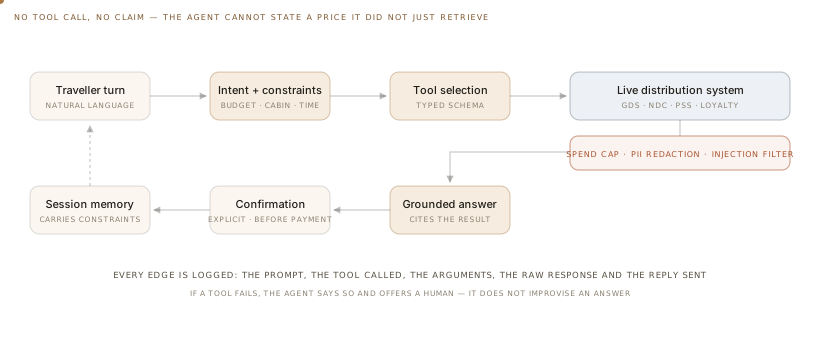
Constraints stated once — a budget, an aisle seat, no red-eyes, a loyalty programme, a child travelling — persist for the session and are re-applied to every subsequent search. When two options genuinely conflict with a stated constraint, the agent asks rather than silently picking one.
Fare rule text is close to unreadable by design. The agent renders the parts that matter — change fee, refundability, baggage, no-show treatment — into a sentence, and attaches the underlying rule paragraph so a human agent can verify the summary rather than trust it.
Deliberate limit: the agent gives visa and entry guidance as advisory only, with a link to the authoritative source. Immigration rules change without notice and getting one wrong strands a passenger — that is not a risk we automate.
Most of the cost in a travel contact centre is post-ticket: changes, reissues, refund eligibility, seat swaps, special assistance. The agent handles these within limits you set, and hands off to the disruption agents when an operational event — not a customer request — is what changed the itinerary.
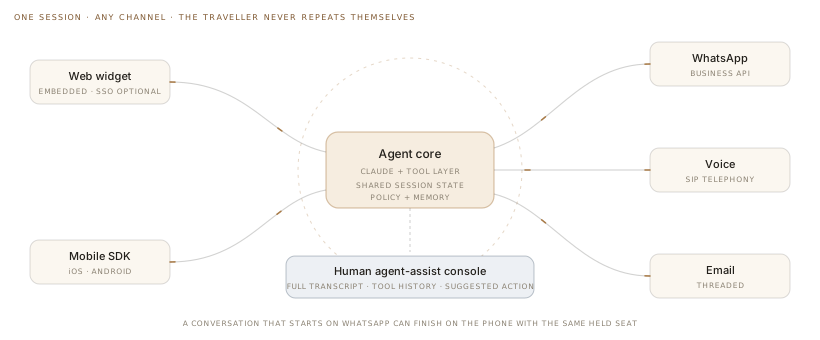
Web, mobile, WhatsApp, voice and email reach the same agent core and share one session. A conversation that starts in the app at breakfast can finish on the phone at the airport with the held seat intact. When it escalates, the human receives the transcript, the tool history and a suggested next action — not a ticket that says "customer needs help".
Spend and refund ceilings are enforced in the tool layer, not requested in the prompt. Retrieved content is treated as untrusted and filtered for injection attempts. Personal data is redacted before anything is written to a log. Every prompt or model change runs against a regression suite of real transcripts before it reaches a traveller.
Walk through it
Six steps from a vague request to an issued ticket. Click a step, or let it run.
Turn 1 · extraction
Tool calls · 1.9 s wall clock
Recommendation with reasoning
Seat map · 12A held
Confirmation gate
The agent cannot reach the payment tool without an affirmative turn immediately following a stated exact total. That constraint lives in the tool layer.
Issued · session stays open
Specifications
Interoperability
Naming a system states interoperability, not partnership or endorsement.
Deployment
Fastest to launch. We run it; you configure policy, tone and limits.
Deployed into your account, VPC-isolated, models reached through your Bedrock.
The agent drafts, a human sends. A low-risk way to build confidence before automating.
Before you ask
The tool layer, not the prompt. The agent has no fare data in its context until a search tool returns one, and the response renderer will not emit a price token that does not appear in a tool result from the current turn. If the search fails, the traveller is told the search failed. Prompt instructions alone are not a control we would sell you.
Commercially that is negotiated, and we do not pretend otherwise. Practically, the controls that matter are the confirmation gate before any charge, per-transaction spend ceilings, and a complete trace of what the traveller asked and what was executed. In pilots we normally start with a low ceiling and an approval gate on anything unusual, then raise the limits as the evidence accumulates.
Inference is passed through at cost with a stated margin on a monthly statement, and every workflow has a hard token budget with alerting. During the pilot we measure actual cost per conversation on your traffic mix, so the rollout price is based on your data rather than an estimate. Runaway cost is a bug, and we treat it as one.
No. The model has to be reachable, whether through the Anthropic API or Bedrock inside your account. We can isolate everything else in your VPC and pin data residency, but if your requirement is a genuinely disconnected deployment, this product cannot meet it and we would rather say so now than during procurement.
The full transcript, every tool call with its arguments and response, the constraints the agent extracted, anything it holds — a seat, a quote, a pending payment — and a suggested next action with its reasoning. The agent also states plainly, in the conversation, why it is handing over. Escalation is a feature, not a failure metric we optimise away.
It does not give definitive visa or immigration rulings — those are advisory with a link to the authority. It does not process name corrections beyond trivial typos, because a name mismatch has consequences a model should not adjudicate. And it does not handle disruption re-accommodation itself; that hands over to the IROPS agents, which work against operational policy rather than customer requests.
Also in the portfolio
The agent drafts, your agents send. You get quality evidence on real traffic before a single traveller talks to it directly — and the switch to autonomy is per intent, not all at once.